
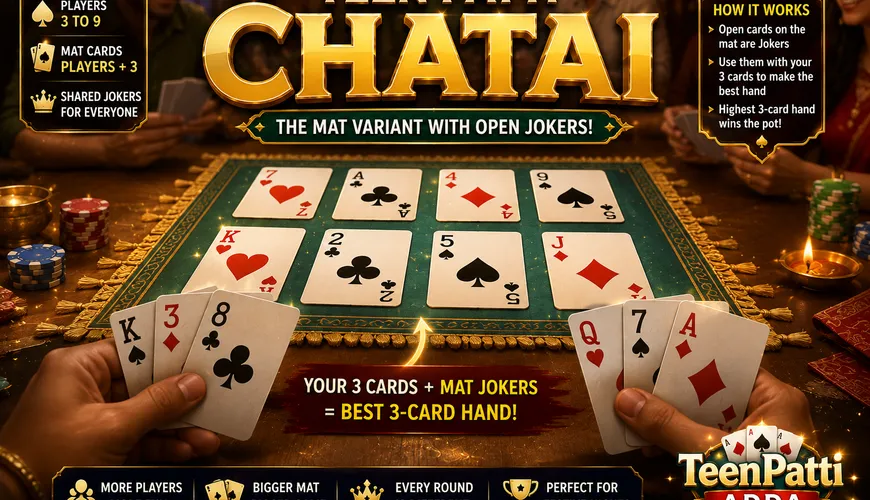
Chatai is the most social, highest-variance variant in the festival rotation. The word “Chatai” (चटाई) means “mat” in Hindi, and that is exactly what defines it: the dealer lays a mat of face-up cards in the centre of the table, and every one of those open cards acts as a shared joker for every player. The bigger the table, the more jokers in play — which is why a 5-to-8 player Diwali game turns into a wild swing of strong hands.
This guide covers what Chatai is, the magic formula that sets the mat size, the full rules, how mat jokers actually work, three worked examples, a side-by-side comparison with other joker variants, the strategy that separates winners from donors, and where to play.
60-Second Answer: Teen Patti Chatai is a variant where, in addition to each player’s 3 closed cards, a “Chatai” (mat) of open face-up cards is arranged in the centre of the table — and all of those open cards act as shared jokers for everyone. With 5 players, the mat has 8 open joker cards (formula: players + 3). The bigger the table, the more jokers in play. This shared-joker setup creates wild swings and is a Diwali favourite across India.
If you’re wondering how to play Teen Patti Chatai, you’ve come to the right place. Understanding the core Chatai rules in Teen Patti and developing a solid Teen Patti Chatai winning strategy is essential before jumping into high-stakes tables.
Chatai Quick Facts Table
| Feature | Detail |
|---|---|
| Game type | Open / shared joker variant |
| Also known as | Mat Teen Patti, Joker Hunt variant |
| Players | 3 to 9 (formula-dependent) |
| Deck | Standard 52 cards |
| Cards dealt to each player | 3 face-down (closed) |
| Mat (Chatai) joker count | Players + 3 open cards |
| Joker scope | Shared — all open jokers usable by all players |
| Hand rankings | Same as Classic (highest wins) |
| Boot amount | ₹100 to ₹2,000 (online); ₹10–₹50 (home) |
| Difficulty | Higher — table-wide joker math |
| Festival popularity | Diwali, Holi family games |
What is Teen Patti Chatai?
The word “Chatai” (चटाई) means “mat” in Hindi — and that is exactly what defines this variant. In the centre of the table, the dealer arranges a mat of face-up cards that serve as shared jokers for every player at the table.
This makes Chatai fundamentally different from AK47, Hukam, or Muflis:
- In AK47, your jokers are in your hand (private knowledge).
- In Hukam, the joker rank is announced but the specific cards stay private.
- In Chatai, the joker cards are visible to all players — and any player can use them.
The magic formula:
$$\text{Chatai (mat) joker cards} = \text{number of players} + 3$$
| Players | Chatai Cards | Cards Left in Deck |
|---|---|---|
| 3 | 6 open jokers | 37 (3 × 3 = 9 dealt + 6 mat = 15 used) |
| 4 | 7 open jokers | 33 (12 dealt + 7 mat = 19 used) |
| 5 | 8 open jokers | 29 (15 dealt + 8 mat = 23 used) |
| 6 | 9 open jokers | 25 |
| 7 | 10 open jokers | 21 |
| 8 | 11 open jokers | 17 |
| 9 | 12 open jokers | 13 (maximum — close to deck cap) |
Why 9 is the max: At 10 players you would need 10 + 3 = 13 mat cards + 30 dealt = 43 cards used, leaving only 9 in the deck — which violates fair-deal rules. Stick to 2–9 players for legitimate Chatai.
Why Indian players love Chatai:
- Transparency — everyone knows which jokers are in play (no hidden information for an unfair edge).
- Wild hands — more jokers in the public pool means bigger and more frequent strong hands.
- Festival fit — large family gatherings of 5–8 players love Chatai during Diwali.
- Strategy depth — figuring out who can use which joker most effectively is real chess.
Chatai Rules — At a Glance
| Rule | Chatai Detail |
|---|---|
| Pre-deal | Mat of (players + 3) cards laid face-up in centre |
| Deal | 3 closed cards face-down per player |
| Joker access | All open mat cards are jokers usable by everyone |
| Hand construction | Combine your 3 closed cards + use mat jokers to make best 3-card hand |
| Betting | Standard Teen Patti betting (Blind / Seen / Chaal) |
| Blind bet | Up to 2× current stake |
| Seen bet | Up to 4× current stake |
| Sideshow | Allowed between Seen players |
| Pack | Allowed any time |
| Showdown | Highest 3-card hand (using jokers from mat) wins |
This betting flow is the standard Teen Patti structure — if you are new to blind, seen, chaal, and sideshow, read the full Teen Patti rules first, then come back for the Chatai-specific joker mechanics below.
How to Play Chatai Teen Patti — Step by Step
Step 1 — Pre-game setup. The dealer counts players and lays out (players + 3) face-up cards in the centre. These form the Chatai (mat) and are visible to everyone.
Example (5 players): Mat shows 7♥, A♣, 4♦, 9♠, K♥, 2♣, 5♠, J♦ (8 open jokers).
Step 2 — Boot collection. Standard boot ante from each player into the pot.
Step 3 — Deal 3 closed cards. Each player receives 3 cards face-down. These are your private hand.
Step 4 — Survey the battlefield. This is the heart of Chatai strategy. Look at:
- Your 3 closed cards.
- All open jokers on the mat.
- What hands you can build using any combination of your closed cards + mat jokers.
Step 5 — Betting. Standard rounds. Note that because every player sees the same mat, everyone has the same joker pool — your edge comes from your closed cards, not the jokers.
Step 6 — Showdown. Reveal closed cards. Each player uses their 3 closed cards + as many mat jokers as needed to make the best possible 3-card hand.
Important: You only build a 3-card hand total. You do not “add” cards from the mat — you use them as substitutes for hypothetical cards in your hand.
How Mat Jokers Work — Hand Construction Rules
This is where Chatai gets tricky. The mat cards are wild jokers, but you build a 3-card final hand.
Method A: Joker as a rank-match
You can claim any mat joker as “matching” one of your closed cards.
Example: Your closed cards are K♠ – 5♥ – 9♦ and the mat shows a 5♦. Use the mat 5♦ as a wild K → K-K-9 (Pair of Kings, 9 kicker). That is stronger than using it to pair the 9s, so always reach for the highest pair the mat allows.
Method B: Joker for sequences
Example: Your closed cards are 3♥ – 4♥ – 6♥ and the mat shows a 5 of any suit. Use the mat 5 as 5♥ → 3-4-5 of hearts (Pure Sequence). Yes — a joker can substitute for any rank and any suit.
Method C: Combining closed cards only (no joker needed)
Example: Your closed cards are A♠ – A♥ – A♦ (you were dealt a natural Trail). Don’t use any mat jokers — you already hold the best possible hand.
If you are unsure which finished hand outranks which, the complete hand rankings chart shows the full 6-hand order Chatai uses at showdown.
Chatai vs Classic, AK47, Hukam — Side-by-Side
| Element | Classic | AK47 | Hukam | Chatai |
|---|---|---|---|---|
| Joker count | 0 | 16 (fixed A/K/4/7) | 4 (random rank) | Players + 3 (random cards) |
| Joker visibility | N/A | Hidden (in hands) | Mostly hidden | All open on mat |
| Joker sharing | N/A | Private to holder | Private to holder | Shared across table |
| Information edge | From closed hands | From closed hands | From closed hands | From closed hands ONLY (jokers public) |
| Trail probability | 0.24% | ~3.5% | ~0.7–1.2% | ~2–4% (varies by mat) |
| Pot growth | Moderate | Fast | Medium-fast | Fastest (everyone has joker access) |
| Bluff frequency | High | Lower | Medium | Lower-medium |
The two closest cousins are AK47, where jokers are fixed and hidden in each player’s hand, and the broader family covered in every Teen Patti variant explained.
Three Worked Chatai Examples
Example 1 — Using a mat joker to complete a Trail
5-player table. Mat shows A♠, 7♦, 9♣, K♥, 4♠, 2♣, 5♥, J♦ (8 open jokers).
Your closed cards: Q♠ – Q♥ – 6♦
Plan:
- You have a natural Pair of Queens (Q-Q).
- Use a mat joker to convert your 6♦ into another Q → Q-Q-Q (Trail of Queens).
Final hand: Trail of Queens. Bet aggressively.
Example 2 — Pure Sequence possibility
4-player table. Mat shows A♣, K♦, Q♥, 10♥, 6♠, 2♣, 7♥ (7 jokers).
Your closed cards: 9♥ – J♥ – 8♠
Plan:
- You already hold 9♥ and J♥ (same suit, near-sequence).
- You need a 10♥ to make the Pure Sequence 9-10-J of hearts.
- The mat has 10♥. Use it as a joker → 9-10-J of hearts (Pure Sequence).
Final hand: Pure Sequence in hearts. A premium hand.
Example 3 — Multiple players can use the same joker
4-player table. Mat shows A♥, K♥, 5♦, 8♠, 3♣, J♥, 4♣ (7 jokers).
- Player A closed: 2♠ – 3♥ – 7♦ → uses mat 3♣ as a 7 → Pair of 7s.
- Player B closed: K♠ – 9♣ – 6♦ → uses mat K♥ to pair the closed K → Pair of Kings (K-K-6).
Does Player B’s claim on K♥ conflict with anyone else using it? No. In Chatai, mat jokers can be conceptually used by multiple players at the same time because they are wild substitutes, not physical cards being moved.
Final: Player B’s Pair of Kings beats Player A’s Pair of 7s.
Winning Strategy for Chatai — 8 Pro Tips
- The mat is information for EVERYONE. Don’t get excited about a great mat — opponents see it too. Your edge is your 3 closed cards.
- Count what hands the mat enables. Before betting, mentally identify the top three possible hands using the mat. If the mat shows 4-5-6-7 in mixed suits, any player with a 3 or 8 can make a Sequence.
- Read who needs which joker. Watch betting patterns. If a player raises hard after seeing the mat, they probably already hold a Pair and the mat completes their Trail. Pack unless you can beat at least a Pair of Queens.
- Closed Pairs are gold. If your 3 closed cards include a natural Pair (Q-Q-anything), you are almost guaranteed to make a Trail using a mat joker. Bet hard.
- Closed-card sequence potential matters more than mat content. If your closed cards are 6-7-anything and the mat has an 8, you might have a Sequence — but the mat is shared, so assume opponents can build similarly.
- Sideshow Seen opponents with high closed Pairs. Sideshow when your closed hand makes you a clear favourite. Avoid it if your hand depends too much on mat jokers, because opponents likely use them too.
- Don’t bluff in Chatai. With 8+ jokers visible to all, most opponents will hold at least a Pair. Bluffs rarely succeed. Play tight and value-bet strong hands.
- Plan for variance. Chatai produces frequent strong hands and frequent close losses. Set a session limit of around 80× the boot and stop when you hit it.
A masterclass Teen Patti Chatai winning strategy involves knowing when to hold and when to fold. For players who enjoy this dynamic, it’s also highly recommended to explore related games like 6 Patti or the equally challenging Rummy.
6 Beginner Mistakes to Avoid in Chatai
- Forgetting to check the mat before betting — your hand strength depends on it.
- Assuming mat jokers are “yours alone” — they are shared. Everyone can use them.
- Not counting the mat size — with 9 players, 12 jokers sit on the mat. That is massive.
- Over-bluffing — opponents have access to the same jokers, so bluffs fail more often.
- Confusing Chatai with 6 Patti — Chatai has closed cards plus a mat; 6 Patti deals 6 closed cards and you pick the best 3.
- Treating mat cards as physical extra cards — they are wild substitutes, not additions to your hand size.
Where to Play Chatai Online in India
Chatai is a rotational, festival-leaning variant rather than an always-on mode, so availability changes through the year. Across our reviewed app pool:
| App | Availability | Notes |
|---|---|---|
| Teen Patti Master | Featured mode | Runs Chatai specials, most reliable place to find a filled table |
| Octro Teen Patti | Rotational | Listed under “Game Modes” |
| Teen Patti Gold | Occasional | Appears in premium rooms |
Chatai needs a fairly full table — 5 to 8 players — to feel right, so it lives best on the apps with the deepest player pools. In our testing, Teen Patti Master is the most reliable place to find a populated Chatai table during festival windows. Treat the other apps as neutral alternatives if a table isn’t filling.
Legality note: Real-money play is restricted in several Indian states including Telangana, Andhra Pradesh, Tamil Nadu, Odisha, Assam, Nagaland, and Sikkim. Free practice with virtual chips is available everywhere.
Chatai Stakes & Boot Structure
These are typical virtual-chip stake tiers you will see in online lobbies. They describe table structure, not earnings — Chatai is high-variance entertainment, and the pot figures below simply show how table size scales the action.
| Stake Level | Boot | Players | Mat Size | Typical Pot |
|---|---|---|---|---|
| Micro | ₹10 | 5–8 | 8–11 cards | ₹500 |
| Low | ₹100 | 5–7 | 8–10 cards | ₹5,000 |
| Mid | ₹500 | 5–6 | 8–9 cards | ₹25,000 |
| High | ₹2,000 | 5 | 8 cards | ₹1,00,000+ |
| VIP | ₹10,000+ | 5 | 8 cards | ₹5,00,000+ |
Responsible Gaming
Chatai is high-energy and high-variance — strong hands and close losses arrive in fast succession. Play for entertainment within limits you set in advance, treat your chips as the cost of a good evening rather than an investment, and never chase losses. 18+ only. If play stops being fun, support is available through national gambling counselling helplines listed on our responsible play page.
What to read next
- Every Teen Patti variant explained — the parent index covering all variants.
- The complete hand rankings chart — the 6-hand order Chatai uses at showdown.
- Full Teen Patti rules — betting flow, boot, blind, seen, show.
- 6 Patti variant guide — the other “more cards” variant Chatai is often confused with.
- AK47 variant guide — the fixed, hidden-joker cousin of Chatai.
- Teen Patti Master app review — the most reliable place to find a filled Chatai table.

Adda · Discussion
Pull up a chair, argue with us
Disagree with something here? Spot a factual error? Got a story from your own table? Drop it below. We read every comment. Be respectful of other players; spam and threats get removed.
Adda comments are warming up. We're finishing the Giscus integration — once the GitHub Discussions backend is wired, comments appear here. Until then, share your take on Telegram and we'll publish notable ones under the launch thread.
(No login wall. No tracking. No ads. The Adda's discussion layer is GitHub-backed, free, and respects your privacy.)