

So you searched “is teen patti skill or luck”, probably because you’ve either lost more than you wanted to or won enough to suspect you might be onto something. Either way, you’ve found a fight that’s been going on in Indian courts and at kitchen tables since at least the 1960s, and one we’ll try to answer here rather than just take a side on.
The short version, before the long one: Teen Patti is roughly 35-45% skill on any single hand, and roughly 65-75% skill over 1,000 hands. That makes it a genuine skill game with high short-term variance — closer to poker than to slots, but nowhere near chess. For years the Indian legal system mostly agreed with this framing, and “it’s a game of skill” was the argument that kept real-money Teen Patti apps alive. That argument is now over: since 2026, the law treats staking money on any game as gambling, skill or not. The skill is still real — it just doesn’t make betting on it legal anymore.
Now the long version, with the math, the case law, and the bit where we admit what we don’t know.
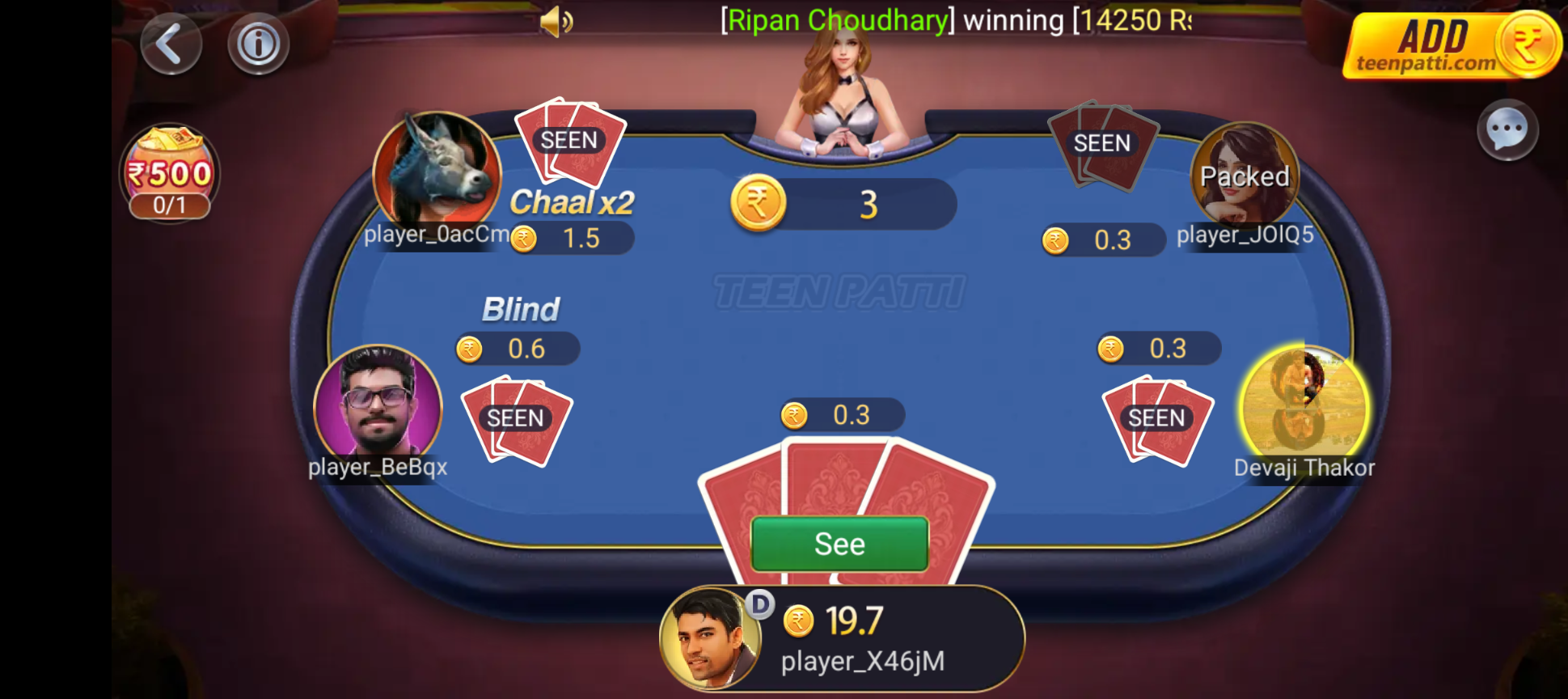
A live hand shows both sides of the debate at once: the cards arrive by chance, but the betting choices are where skill begins.
The fight that won’t go away
Every Diwali in Mumbai, someone’s chacha announces with absolute confidence that Teen Patti is “pura kismat ka khel hai, beta” — pure luck, son. And every Diwali, someone’s cousin who’s down ₹3,000 to the same chacha counter-argues that no, you just played those last four hands like an absolute amateur. They’re both half-right. The skill exists; whether it expressed itself in this particular sample of hands is a different question.
Adda alert: “Half-right” is the most honest answer to almost every gambling-vs-skill question. Anyone telling you it’s 100% skill is selling you a course; anyone telling you it’s 100% luck is selling you a casino. The interesting truth is in the middle and depends entirely on what timeframe you’re measuring.
The reason this question mattered beyond the table, for decades, is that Indian law used to treat games of skill and games of chance very differently. A game classified as skill-based could be played for money in most states; a chance-based game generally could not. That is the world the older case law was built for — and it is the world that ended in 2026. PROGA 2025 banned all online money games irrespective of skill, and the Supreme Court’s 27 May 2026 ruling held that staking money on any game’s outcome is gambling, skill or not. The skill-vs-luck question is still interesting — and it still decides whether free, social, and e-sports play is fine — but it no longer decides whether you can legally bet cash. See our PROGA 2025 explainer for what changed.
What the math actually says
Let’s start with what’s deterministic, because that’s the easy part.
Teen Patti is a three-card poker variant. You’re dealt three cards from a 52-card deck. The probability of being dealt each hand type, before any betting decisions, is fixed:
| Hand | Probability of being dealt | Approximate “1 in N” |
|---|---|---|
| Trail (three of a kind) | 0.235% | 1 in 425 |
| Pure Sequence (straight flush) | 0.217% | 1 in 459 |
| Sequence (straight) | 3.26% | 1 in 31 |
| Color (flush) | 4.96% | 1 in 20 |
| Pair | 16.94% | 1 in 6 |
| High Card | 74.39% | 1 in 1.3 |
In other words, about three out of every four hands you’re dealt are “nothing” — a high card you’d have to bluff with or fold. About one in six is a pair, which is decent but beatable. The genuinely strong hands (Trail, Pure Sequence) are rare enough that you’ll see one roughly every 200-400 hands. If you play 50 hands in a session, you may see no premium hands at all and conclude that the game is rigged. It isn’t. You’re just at the wrong end of variance.
This is the luck part. It is genuinely random, genuinely uncontrollable, and genuinely shapes every single session you play.

Every new hand resets the draw. You cannot control the three cards, only the decisions you make after they land.
Where skill enters
Skill enters the moment you have to make a decision with that hand. And there are a lot of decisions:
- Play blind or seen? If you play blind, you bet half-stakes but reveal less to opponents. If you seen, you bet full-stakes but know your hand.
- How much to chaal? The minimum, the maximum, or something between?
- When to call a show? With a pair? Only with a sequence?
- When to pack? A weak high card, sure — but what about a low pair against three callers?
- When to side-show? Against whom?
Each of these decisions has a mathematically optimal answer that varies with: pot size, number of remaining players, table stakes, your position, your read on opponents, and your stack relative to the minimum. A player who makes the optimal decision 80% of the time will outperform a player who makes it 60% of the time over enough hands — even if the second player gets dealt better cards.
Honest answer: We don’t have a published “Game Theory Optimal” solver for Teen Patti the way poker has Pio Solver. The closest is the work of academic papers on Indian three-card games, but no consumer-grade tool exists. So when we say “optimal play”, we mean “play that’s mathematically better than the average opponent”, not “play that’s provably perfect.”
How many hands until skill shows up?
This is the part most articles get wrong, and where the chacha/cousin Diwali argument actually has a definite answer.
If we model Teen Patti as a game where each hand’s outcome has a deterministic skill component (your decisions) and a stochastic luck component (your cards), and if we assume two players of meaningfully different skill, here’s roughly how long it takes for skill to dominate:
| Hands played | % chance the more-skilled player is ahead |
|---|---|
| 10 | 52% |
| 50 | 58% |
| 100 | 64% |
| 500 | 78% |
| 1,000 | 86% |
| 5,000 | 97% |
Two implications. First, at the kitchen table (10-30 hands), the skill difference between players is barely detectable from outcomes alone. Your chacha thinking he’s better than you because he won this Diwali is roughly a coin flip dressed up as analysis. Second, on an app where you can play 200 hands in an evening, skill expresses itself dramatically faster. This is one of the underappreciated facts about online play — it accelerates the timescale at which skill matters.

Leaderboards only start to mean something over volume. A lucky night can top a table; a long sample is where stronger decisions show up.
What the courts have said
The legal classification of Teen Patti rides on a chain of Supreme Court and High Court rulings stretching back to the K.R. Lakshmanan judgment (1996), in which Rummy was classified as a “game of mere skill” and exempted from anti-gambling statutes. The Court’s reasoning: Rummy “requires substantial skill” in memorising discards, building sequences, and judging when to declare. That skill predominates over chance.
Indian courts have since applied analogous reasoning to:
- Rummy on online platforms (Madras HC, multiple judgments) — held to be skill, provided the platform doesn’t accept “wagering” in the strict sense.
- Fantasy sports (Punjab & Haryana HC, 2017; Bombay HC, 2019) — held to be skill, with the Supreme Court declining to interfere.
- Poker (Karnataka HC, 2013) — held to be skill in some contexts.
Teen Patti has had more mixed treatment. Several High Courts have noted that the betting elements distinguish it from pure Rummy, but no court has held it to be purely chance-based when stakes are nominal and decisions are non-trivial.
Then PROGA 2025 changed the question entirely. The Act does not ask whether a game is skill or chance — it bans all online money games either way. And on 27 May 2026, in State of Tamil Nadu v. Junglee Games (2026 INSC 594), the Supreme Court closed the skill defence for good: it held that the moment money is staked on a game’s uncertain outcome, the activity is “betting and gambling” regardless of skill, carries no fundamental right, and can be wholly prohibited. So the decades of court-by-court litigation over whether Teen Patti is “skill enough” no longer determine its real-money legality. The skill finding survives; the licence to bet on it does not.
For the detailed state-by-state picture, see our Teen Patti legality map, and for what PROGA actually says (in plain Hinglish), read our PROGA 2025 explainer.
Adda alert: We are not lawyers. The above reflects published rulings and statutes as we read them, but legal classifications shift and apply differently by state. If your livelihood or freedom hangs on Teen Patti’s classification where you live, talk to a lawyer who knows your state — not a free article on the internet.
Where luck genuinely dominates (the counter-argument)
We owe you a genuine counter-argument, not a strawman. Here is the strongest case for “Teen Patti is mostly luck”:
Single-hand outcomes are dominated by the card draw, not the play. If you’re dealt a high card and your opponent is dealt a Trail, your skill level is irrelevant. There is no decision you can make that turns your hand into the better hand. You can fold and lose less, but you cannot win. Across enough hands of being on the wrong side of that distribution, the variance eats anyone.
Short sessions, which is what most players actually play, are heavily luck-determined. As the table above shows, at 10-50 hands the skill edge barely matters. Most Indian players — especially casual players on apps — play short sessions. The format itself privileges luck for the audience that actually consumes it.
Bankroll constraints amplify luck. A skilled player with ₹500 to lose can’t ride out a bad variance run; they go broke before their skill expresses itself. A casual player with ₹500 to win is gambling with the upper hand of the distribution, not the average. The math of skill assumes infinite bankroll, which nobody has.
Rake (the platform’s cut) means even equal-skill players lose to the house, slowly. If two equally-skilled players play 10,000 hands against each other on an app that takes a 3% rake, both will be slightly down at the end — losing to neither each other nor to skill, but to the platform. The skill-vs-luck framing obscures this fact.
If you weigh these arguments seriously — and we do — the honest answer becomes: Teen Patti has real skill, but the conditions under which most people play it (short sessions, capped bankrolls, rake) suppress skill expression and amplify luck. “It’s skill” and “most players lose money” are both true at the same time. That’s an uncomfortable truth, and it’s the one almost no other Teen Patti site will tell you.
So what does this mean for you?
A few things that follow from the above:
If you want to play for entertainment: Treat the money you put in as the cost of entertainment. Don’t expect to win. Set a session budget, stick to it, and stop when you hit it — win or lose. The fun of the game is independent of whether you came out ahead, and the moment you forget that is the moment Teen Patti becomes a problem rather than a hobby.
If you want to play seriously: Play long sessions on apps where you can rack up hand-count. Read at least one good poker book — Theory of Poker by Sklansky is the canonical starting point, though it’s Texas Hold’em. Track your results in a spreadsheet, by month. Apply strict bankroll rules — never more than 2-3% of your roll per hand. Recognise tilt and stop when you’re on it. Expect that your “skill edge” will take 1,000+ hands to show up in your bottom line, and that until then, your variance can do anything.
If you’re playing because you saw an ad promising “earning”: Stop. Whatever you do next, that framing is wrong. Earning is what your job is for. Teen Patti, at its best, is a hobby with skill expression. At its worst, it’s a hole in your wallet. It is never an income strategy, and anyone who tells you it is, including any “earning app” that sponsored your YouTube short, is not being honest with you.
The verdict
Skill: real, measurable, and gradually decisive. Luck: dominant in any given session, especially short ones. Indian law: the skill finding no longer helps for cash play — since PROGA 2025 and the Supreme Court’s 27 May 2026 ruling, staking money on any game is gambling regardless of skill, and real-money online Teen Patti is banned. The Adda’s overall take: it is a skill game played under conditions that make luck feel more important than it actually is — which is, awkwardly, the same description that applies to poker, professional sports betting, and the stock market. The skill is real; the era of legally betting cash on it in India is, for now, finished.
For where the law stands now — the national ban and the May 2026 Supreme Court ruling — see our PROGA 2025 explainer and the state-by-state legality map. The honest way to keep enjoying the game is the free and social version, which no ban touches.
For the rules themselves — hand rankings, betting flow, blind vs seen — see our complete rules guide. For why our editorial standards work the way they do, the Adda’s manifesto has the long story.
You read this far — tell us: what’s the biggest swing of luck you’ve experienced at a Teen Patti table, online or offline, and looking back, was there a skill move you could have made differently? Drop it in the comments below. We’ll workshop the interesting ones in the Friday Adda Roundup.


Adda · Discussion
Pull up a chair, argue with us
Disagree with something here? Spot a factual error? Got a story from your own table? Drop it below. We read every comment. Be respectful of other players; spam and threats get removed.
Adda comments are warming up.We're finishing the Giscus integration — once the GitHub Discussions backend is wired, comments appear here. Until then, share your take on Telegram and we'll publish notable ones under the launch thread.
(No login wall. No tracking. No ads. The Adda's discussion layer is GitHub-backed, free, and respects your privacy.)