
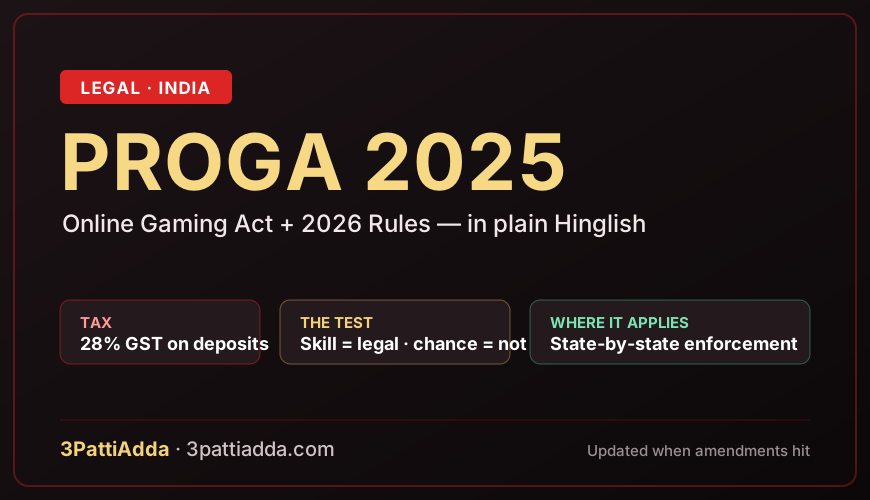
Your chacha calls. “Beta, ye PROGA kya hai? Teen Patti band ho gaya kya? Mere paise ka kya hoga?”
This time the honest answer is short, and it is not the one most operators want you to hear: real-money Teen Patti is now banned in India. Not “regulated”, not “needs a licence” — banned. Skill ya chance, koi farak nahi padta. The law that does it is PROGA, and it came into force on 1 May 2026.
Most articles you’ll find online are either operator press releases pretending nothing has changed, or panic-blog SEO farms claiming the wrong things are banned. Neither is straight with you. What follows is what the law actually says, what it actually does, and which parts actually touch you. It is not legal advice — for that, call a lawyer who knows your situation. But it should let you have a real conversation with chacha next Diwali.
The 30-second version
PROGA — the Promotion and Regulation of Online Gaming Act, 2025 — was passed by Parliament in August 2025 (Lok Sabha 20 August, Rajya Sabha 21 August, President’s assent 22 August). The operational Rules 2026 were notified by MeitY on 22 April 2026, and the Act plus Rules came into force together on 1 May 2026. Here is what it does:
- Bans every online “money game” — skill, chance, or both. If you pay money (or stakes that convert to money) hoping to win money back, the game is banned. Teen Patti for cash, online Rummy for cash, online Poker, fantasy sports, opinion-trading — all of it, irrespective of how much skill the game involves.
- Promotes two clean categories instead. E-sports (competitive skill games with entry fees and prize money, but no betting on the result) and online social games (play for fun, no cash-out) are recognised and encouraged.
- Criminalises offering, advertising, and bankrolling money games. Operators, advertisers, and the banks/payment apps that move the money all face jail and fines.
- Gives the Government power to block offending apps, websites, and payments.
The headline takeaway, said plainly: the skill-vs-chance debate is over for real-money play. For twenty years operators argued “Teen Patti and Rummy are games of skill, so they’re not gambling.” PROGA closes that door, and on 27 May 2026 the Supreme Court slammed it shut (more on that below). Free Teen Patti — chips with no cash value, family games at Diwali — is untouched. Cash Teen Patti on an app is now illegal to offer in India.
What PROGA actually says
Three buckets, not one
The whole Act turns on which of three buckets a game falls into.
- Online money game — any game where a user pays money or stakes (cash, coins, credits, tokens that convert to money) in the expectation of winning money or other enrichment. This bucket is banned outright. The Act is explicit that it does not matter whether the game is “based on skill, chance, or both.” Cash Teen Patti lives here, and that is why it is gone.
- E-sports — competitive games decided by physical dexterity, mental agility or strategic thinking, run as organised tournaments with pre-declared rules. Entry fees and prize money are allowed; betting on the outcome is not. Recognised and promoted.
- Online social game — a game played purely for recreation, entertainment or skill-building. A subscription or access fee is fine, but you cannot stake money to win money. Allowed. This is where free-chip Teen Patti sits.
Adda alert: Notice what PROGA killed: it did not “ban Teen Patti the game.” It banned the money on top of the game. The card game is fine. The cash-out is the crime. That distinction is the single most important thing in this whole law, so read it twice.
What is prohibited
Under the Act it is an offence to:
- Offer or run an online money gaming service — including foreign and offshore operators who let Indian users sign up. PROGA reaches operators based in Curaçao, Malta or the Isle of Man the moment they serve an Indian player.
- Advertise or promote an online money game in any form, on any platform.
- Facilitate financial transactions for a money game — this is the one that bites banks, UPI, payment gateways and intermediaries. They are not allowed to process deposits or withdrawals for a banned operator.
- The Government may also block the offending app, website or information from public access.
Adda alert: “Regardless of where the operator is based” is doing a lot of work here. Plenty of “Teen Patti real cash” apps you’ll still see are offshore outfits ignoring Indian law. PROGA’s answer is not to chase them across borders — it is to choke the money. Once banks and UPI cannot legally move funds to them, and the Play Store and App Store pull them, the app on your phone becomes a wallet you can put money into but may never get money out of.
The penalties
These are real, and they are graded:
- Offering an online money gaming service: up to 3 years’ imprisonment and/or a fine up to ₹1 crore.
- Advertising an online money game: up to 2 years and/or up to ₹50 lakh.
- Facilitating financial transactions for one: up to 3 years and/or up to ₹1 crore.
- Repeat offences carry enhanced punishment, and the operator-side offences are designed to be serious — cognizable, with company directors exposed to personal liability.
Honest answer: Notice who is in the firing line — operators, advertisers, and the banks/payment firms. The Act’s offences are written for the people running and bankrolling the games, not for the aam aadmi who opens an app for a hand of Teen Patti. The central Act does not create a “you played, now go to jail” offence for an ordinary player. But do not read that as “so I can still play safely.” There is no longer a legal cash game to play. Putting money into an illegal offshore operator is not a PROGA crime for you — it is just a fast way to lose your deposit with zero recourse.
Who enforces it
The Act is administered by MeitY (the Ministry of Electronics and Information Technology) and empowers the Central Government to set up a national authority to classify games and to register the legitimate categories (e-sports and social games). The enforcement muscle is the blocking power plus the financial-facilitation offence — both aimed at making it impossible to run a money game at scale in India, rather than at prosecuting players one by one.
The Supreme Court just made it much harder to undo
The online-gaming industry challenged all of this — both the central Act and the older state bans — arguing that skill games are constitutionally protected trade under Article 19(1)(g), and that a state (or Parliament) cannot simply ban them. For months the challenge sat with a three-judge bench of the Supreme Court, with hearings pushed from January 2026 onward.
Then, on 27 May 2026, the Court delivered State of Tamil Nadu v. Junglee Games India Pvt. Ltd. (2026 INSC 594). The bench of Justices J.B. Pardiwala and R. Mahadevan held, in plain terms:
- The moment you stake money on the uncertain outcome of a game, it is “betting and gambling” — full stop, irrespective of whether the game is skill or chance. The skill defence protects the game; it does not protect the wager on the game.
- Betting and gambling is res extra commercium — outside the realm of legitimate trade — so there is no fundamental right under Article 19(1)(g) to run it. With no right at stake, the state does not even have to clear the usual proportionality test.
- State legislatures are fully competent (Entry 34 plus the public-order Entry 1 of the State List) to regulate, restrict or wholly prohibit online money gaming — including online Rummy, Poker and fantasy sports.
- The Court upheld the Tamil Nadu and Karnataka laws and set aside the High Court judgments that had earlier struck them down.
The line that made every headline: the Court observed that “every mobile phone has become a virtual common gambling house,” and described online-money-gaming addiction — with its trail of debt and suicides — as a threat to public health.
Honest answer: This ruling is why we are not hedging. Before 27 May you could argue the industry might win at the Supreme Court and reopen cash Teen Patti. After 27 May, that argument is dead. The Court did not just uphold two state bans — it knocked out the constitutional theory the whole real-money industry was built on. PROGA and the state bans now sit on top of an SC judgment that says staking money is gambling, skill ya na skill.
What PROGA does NOT do
Three things people get wrong:
It doesn’t touch free or social play. Practice tables, demo modes, chips that have no cash-out value — none of this is a “money game” under PROGA. Playing free Teen Patti with your cousins on a Sunday is completely fine. The Act actually promotes this category.
It doesn’t ban e-sports. Genuine competitive gaming — entry fee, prize pool, no betting on the result — is recognised and encouraged. The Act is trying to grow that side while killing the money-game side.
It doesn’t criminalise the ordinary player. The offences target operators, advertisers and money-movers. That is cold comfort, though, because the same Act removes every legal cash game you might have played. The risk to you is not a PROGA prosecution — it is handing your money to an illegal operator who can vanish with it.
So what changed on your phone
If you used a real-money Teen Patti app, here is the lived reality since 1 May 2026:
- Compliant Indian operators shut their cash tables or pivoted to free/social play to survive.
- Payment rails dried up. Banks and UPI are not allowed to process money-game transactions; deposits and withdrawals to offshore cash apps started failing or getting flagged.
- App Store and Play Store removals accelerated, and the ad networks (Google, Meta) had already pulled the category.
- The apps still pushing “Teen Patti real cash” to Indian users are now operating in open violation of Indian law — usually offshore, with all the deposit-disappears-on-withdrawal risk that implies.
A note on tax — mostly history now
You’ll still see old guides quoting Section 115BBJ (30% flat tax on net online-gaming winnings) and 28% GST on deposits. Those were the rules of the pre-ban world, when real-money play was a grey-zone-but-taxed activity. With the activity itself now banned, that regime is largely behind us for legal Indian play. If you have legacy winnings from before the ban, you still declare them in your ITR — winnings are taxable whether or not they came from an activity that is now prohibited. But “how much TDS will the app cut” is no longer a live question, because the legal app cutting it is no longer there.
So, chacha — what do you tell him?
“Chacha, Teen Patti khelna band nahi hua — paise wala Teen Patti band ho gaya. Naya kanoon hai, 1 May se laagu. Cash wala koi bhi online game — skill ho ya luck — ab illegal hai. Free Teen Patti, ghar pe Diwali wala, woh bilkul theek hai. Aur 27 May ko Supreme Court ne bhi keh diya — paisa lagaya, toh woh juaa hai, chahe game mein skill kitni bhi ho. Toh jo app ‘real cash, paise jeeto’ bol raha hai — usse door raho. Woh ya toh band ho chuka hai, ya kaanoon tod raha hai, aur tumhara paisa wapas nahi aayega.”
That, roughly, is what PROGA 2025 means for an Indian Teen Patti player. The skill-vs-chance argument that kept cash games alive for two decades is finished — the Act ended it and the Supreme Court buried it. The card game survives; the cash on top of it does not. If you love Teen Patti, the honest path now is the free and social version — and that one nobody can take away from you.
For the deeper math on why “it’s a game of skill” was never the same thing as “so it’s legal to bet on,” see our skill vs luck breakdown. For where each state stands now that the national ban overlays the older state laws, see the state-by-state legality page. And for the editorial standards that govern how we cover all of this, the Adda manifesto.
Question for you: has the ban actually stopped real-money play in your circle, or just pushed people toward dodgy offshore apps? We’re collecting reader experiences for a follow-up on the lived effects of the rollout. Drop your story in the comments.

Adda · Discussion
Pull up a chair, argue with us
Disagree with something here? Spot a factual error? Got a story from your own table? Drop it below. We read every comment. Be respectful of other players; spam and threats get removed.
Adda comments are warming up.We're finishing the Giscus integration — once the GitHub Discussions backend is wired, comments appear here. Until then, share your take on Telegram and we'll publish notable ones under the launch thread.
(No login wall. No tracking. No ads. The Adda's discussion layer is GitHub-backed, free, and respects your privacy.)